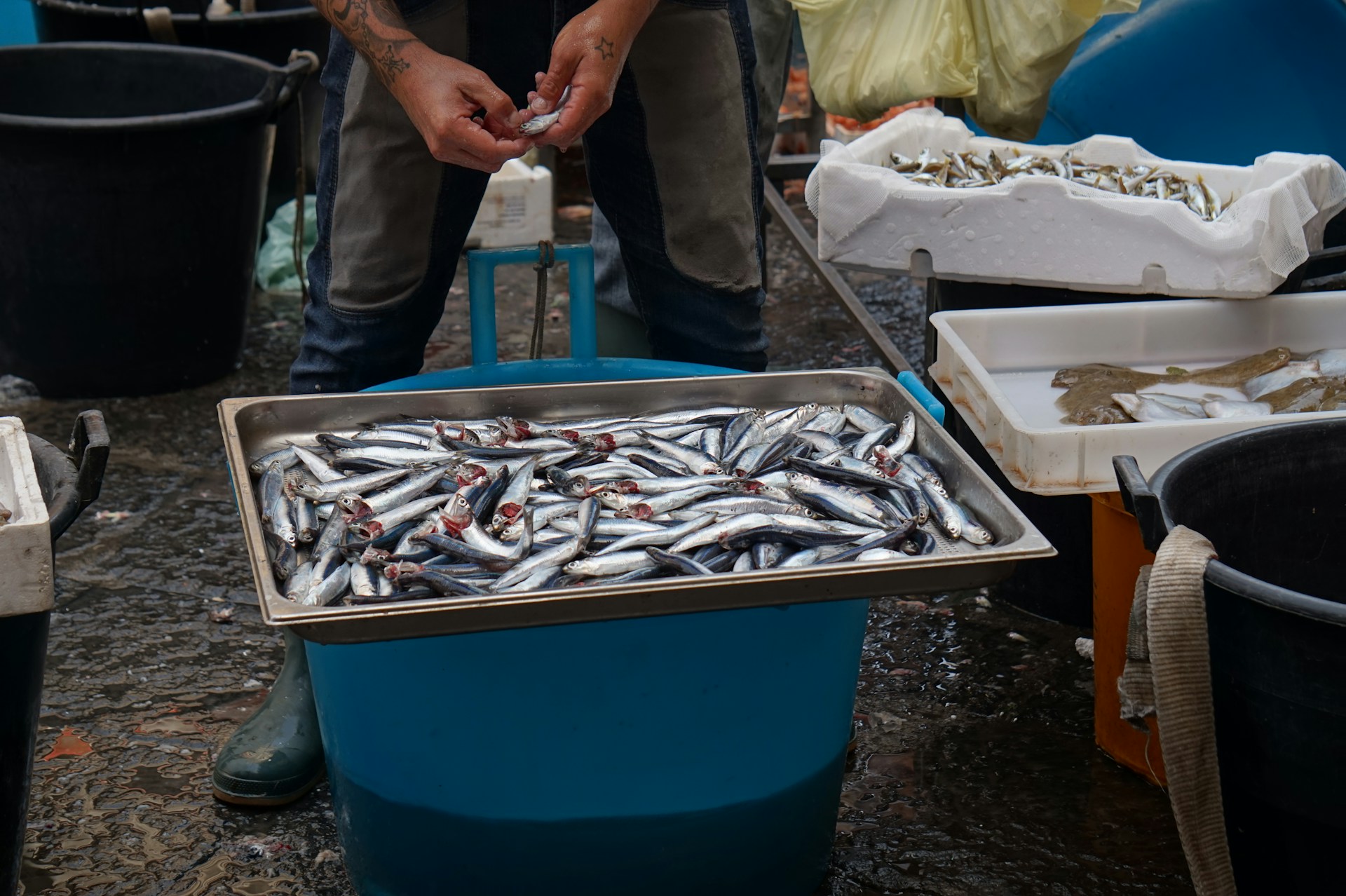
In Catania, we have a fish market where fishermen bring in their catch from the last 24 hours and sell fish and other seafood, some of it even still alive and moving, to people who peruse the market nearly every morning. I’m reminded of that market this morning as I read about the men that Jesus chose to be his disciples and apostles:
One of those days Jesus went out to a mountainside to pray, and spent the night praying to God. When morning came, he called his disciples to him and chose twelve of them, whom he also designated apostles: Simon (whom he named Peter), his brother Andrew, James, John, Philip, Bartholomew, Matthew, Thomas, James son of Alphaeus, Simon who was called the Zealot, Judas son of James, and Judas Iscariot, who became a traitor.
Luke 6:12-16
The first four of the disciples – Simon Peter, Andrew, James, and John – were all fishermen. Assuming that they were like most of the fishermen that we see here in Catania who bring in their catch each day, we can assume that they have a very particular type of character. They would have likely been pretty “rough around the edges”. They may have been brash. They may have been loud. They may have used bad language and told bad jokes. Yes, they would have been influenced by their Jewish religion and culture, but I think it is fair to assume that influence would not have necessarily made them to be saints, to be the perfect religious people that we might expect from a sanitized understanding of what it means to follow Jesus.
Yet these four fishermen were amongst, and in fact the first amongst, the disciples that Jesus specifically chose. Except to the extent that they responded to Jesus’s call when he told them that he would teach them to fish for men instead of just fish, it wasn’t the choice that they made. No, it was the choice that Jesus made. Jesus chose these men. These men that we might consider less-than-ideal for the job, these men amongst many others from which Jesus chose the twelve, these are the men that he chose.
It was almost as if Jesus was looking for a challenge, an added challenge even beyond the fact that he came to teach a lost world and die for it. Jesus looked beyond the outer appearance. He saw not what they were at that time, but what they would become. In Jesus’s case, of course, he also had foresight, something that we do not have. He knew in selecting the disciples, for example, that Judas would betray him. Judas was chosen because Jesus had the eternal foresight to know that would happen, that Judas would betray him and send him to his death. And Jesus also knew the purpose for each of the other disciples as well. He was building his kingdom and each person would play their part in his plan.
In our society today, we have a value to look beyond the outer appearance of each person. Our hope and desire is to try to consider the inner character of a person instead of other traits such as race, gender, socioeconomic status, or other outward appearances. I would argue that even for all of our attempts to do this and all of the societal reminders and pressures, we still fail at this a very significant percentage of the time.
As human beings, we have a tendency to prejudge, to discriminate, to rule someone out based on how we see them, both from an outward appearance as well as through a judgment of their character. It is notable, though, that this is the opposite of what Jesus did. He knew that the Gospel, when truly understood and lived out, changes people completely. It doesn’t change just their behavior. It doesn’t just change the outward behavior. The Gospel changes people from within. Their inner person, their character. It makes them into an entirely new and different person who does new and different things with their life. It allows them to make new decisions and live according to new priorities, putting aside the priorities of our world and instead living by those of the kingdom of God.
This is a significant challenge when we think about being a disciple-maker, making disciples of Christ among people who, today, don’t seem to be likely candidates. Just as Jesus chose twelve men who did not seem, externally, as the right and most likely people to succeed, we also are looking at a similar world, people with the same faults and failures that we eventually see in these men, the disciples that Jesus chose. We can imagine as well that there will be many faults and failures amongst those with whom we are working. In fact, we ourselves will fall and routinely fail in fully living out the calling of Christ in each area of our lives.
Yet just as Christ continues to allow us to repent, get back up, and continue to serve him, we also must have this same type of vision and perseverance with others with whom we are working. We cannot even begin to imagine that we can choose the way of Christ and his kingdom for other people, but the key is to not prejudge, nor to write people off or dismiss them upon failure. We know that Peter, for example, denied Christ, but in fact, every one of his disciples abandoned him, or even worse, betrayed him in the end. We can expect that this will be the same in our work as disciple-makers as well.
This is not a “clean” business. Making disciples doesn’t look like a nice Sunday morning church service with everyone sitting in the pews, shaking hands with one another, singing songs and then smiling and nodding along with the sermon. Instead, we enter into the messy lives of the people with whom we are discipling. We choose to do this, though, working with them with a vision of the person whom Christ has called them to be, helping them to live out the full identity of a new creation in Christ that he has already made each of us to be.
We must, therefore, follow Christ’s example. We cannot prejudge, but instead we must sow the seed and look for those who will respond by bearing fruit. Even if that fruit is very small at first, it is a first step among what we hope will be many to come in the future. We cannot give up, but instead, despite the failings, the betrayals, the quitting, and many more problems that we will encounter in relationship with those with whom we are discipling, we pray and ask God to help each of the people with whom God has entrusted us to know Christ to bear fruit for his glory.